Curious about IE7, I installed the beta preview.
The browser itself looks OK. Basically it's Firefox look and feel. Tabs. Wow. I'm interested in exploring the RSS/Atom support but did not get the chance to exercise much. They do have a little "subscribe" icon that looks just like Firefox's. It makes you wonder: If it takes the equivalent of a space program to catch up to dinky little Firefox and feed aggregators, how is MS going to keep up with whatever comes next? They'll be starting out a nose behind. The little guys will blazing new continents before MS ships Vista.
About ten hours later, I had to do System Restore to get back to IE6. Principally, that's because I was working on a project using somewhat unfamiliar tools ( Nullsoft Installer and VS 2003) and needing the online help a lot. After installing IE7, almost no pages were visible in the Nullsfoft CHM, and all the pages lost their styling in VS online help.
Demonstrating the tightly coupled Microsoft world: Install IE7 and you'll be "upgrading" several other products that used to work just fine.
Wednesday, February 22, 2006

Wednesday, February 15, 2006
Nokia, Ericsson gonna slap you upside the head
Fear, uncertainty, and doubt being spread by Iron Mountain to get webheads to enroll in their seminar:
In May 2006 the new global .MOBI top-level domain extension is expected to arrive. It’s not the usual "yada-yada" new domain extension. It’s backed by major players in the mobile world, like Ericsson, GSM Association, Hutchison, Microsoft, Nokia, Samsung Electronics, Syniverse Technologies, Telefonica Moviles, TIM, T-Mobile and Vodafone. These investors are serious about bringing a much better and consistent mobile browsing experience to all users no matter what device they may be using. They plan on enforcing certain web site formatting requirements. Failure to comply may mean you are shut out reaching mobile users, even if you meet all legal requirements for registering a .MOBI domain name.
Tuesday, February 14, 2006
Oracle acquires Sleepycat
I lost a whole day today because a Berkeley DB file hit 2^31-1 bytes, jamming our subversion repository. That's when I discovered svn has migrated to using its own fsfs filesystem (we skipped two svn revs).
Then at the end of the day we get the news: Oracle acquires Sleepycat, maintainer of BDB, as part of its continuing rollup of open source (InnoDB, Sleepycat) and small private (Times Ten) database providers. I'm no fan of Sleepycat, and I admire Oracle DB; but this is giving me the creeps.
Nice job change, Mike.
Then at the end of the day we get the news: Oracle acquires Sleepycat, maintainer of BDB, as part of its continuing rollup of open source (InnoDB, Sleepycat) and small private (Times Ten) database providers. I'm no fan of Sleepycat, and I admire Oracle DB; but this is giving me the creeps.
Dear Hugh,
I'm pleased to announce today that Sleepycat Software has been acquired by Oracle.
By joining the leading database company in the world, I expect that we will be able to serve our customers and the open source community better. With the additional expertise, resources and reach of Oracle, we'll be able to accelerate innovation, offer you greater choice, and provide more complete solutions. For Oracle, we fill a gap in the product portfolio for high performance embedded/edge databases, an area which we believe is a significant and growing opportunity....We look forward to working with you as part of Oracle!
....
Regards,
Mike Olson
Vice President, Oracle
Former President and CEO
Sleepycat Software
Nice job change, Mike.
Sunday, February 12, 2006
We can hack this too
Via Kim Cameron: Companies are injecting employees with RFID chips.
My pet theory is that efforts to use technology to nail down identities are the more hackable, the more confidence authorities place in them. It's a corollary to Edward Luttwak's thesis in Strategy: The Logic of War and Peace, summarized in one review as
My pet theory is that efforts to use technology to nail down identities are the more hackable, the more confidence authorities place in them. It's a corollary to Edward Luttwak's thesis in Strategy: The Logic of War and Peace, summarized in one review as
The crucial question to be asked of any new tactic, strategy, or technology is not: “how will this affect battle?” but “how will the enemy react?”
Wednesday, February 08, 2006
Patterns: Another Way To Say "Bloat"
A quote I'd missed at the very end of this oft-linked Paul Graham essay:
It's elementary information theory, sir. Any pattern, or predictable part, of the signal is non-informative bit bloat. Compression programs work by identifying predictable patterns and encoding them simply: if the pattern recurs, you don't have to repeat it verbatim. You can just say, e.g. "Pattern 3 again" to substitute for the longer sequence.
It's the same with programming. Coding patterns is cut and paste. Eclipse will even help you do it, in Java; it has all sorts of nifty shortcut keys to do patterns like "return an array from a collection instance." That's reverse compression: You type Ctrl-Shift-J or whatever, and Eclipse expands it into the pattern for you.
Here's a pattern that gripes me in java: for data access, I usually make two methods for each thing I want to access. Both methods accept all the parameters you need to select the thing; but one method accepts a JDBC connection parameter, while the other constructs and destroys the connection and calls into the first method. The second method is a convenience procedure, while the first one allows you to make the call as part of a series of actions withing the same transaction. You know...
I have cut and paste that snippet about five hundred times.
I want a way to avoid both compile time and run time bloat. I don't just want a magic macro that saves source code; I want the actual wrapper code to be generic. I asked my friend and colleague Brad to sketch a Lisp solution:
I'm going to learn Lisp!
...in the OO world you hear a good deal about "patterns". I wonder if these patterns are not sometimes evidence of case (c), the human compiler, at work. When I see patterns in my programs, I consider it a sign of trouble.
It's elementary information theory, sir. Any pattern, or predictable part, of the signal is non-informative bit bloat. Compression programs work by identifying predictable patterns and encoding them simply: if the pattern recurs, you don't have to repeat it verbatim. You can just say, e.g. "Pattern 3 again" to substitute for the longer sequence.
It's the same with programming. Coding patterns is cut and paste. Eclipse will even help you do it, in Java; it has all sorts of nifty shortcut keys to do patterns like "return an array from a collection instance." That's reverse compression: You type Ctrl-Shift-J or whatever, and Eclipse expands it into the pattern for you.
Here's a pattern that gripes me in java: for data access, I usually make two methods for each thing I want to access. Both methods accept all the parameters you need to select the thing; but one method accepts a JDBC connection parameter, while the other constructs and destroys the connection and calls into the first method. The second method is a convenience procedure, while the first one allows you to make the call as part of a series of actions withing the same transaction. You know...
   public static long getMetainfoId(UID uid, String objectType){
       try {
           // notice the pattern within a pattern below (service locator)
           Connection conn = ServiceLocator.getInstance().getDataSource().getConnection();

           try {
               return getMetainfoId(conn, uid, objectType);
           } finally{
               conn.close();
           }

       } catch (Exception e) {
           throw new RuntimeException(e);
       } finally {

       }

   }

   public static long getMetainfoId(Connection conn, UID uid, String objectType){
      .... do the real work
   }
I have cut and paste that snippet about five hundred times.
I want a way to avoid both compile time and run time bloat. I don't just want a magic macro that saves source code; I want the actual wrapper code to be generic. I asked my friend and colleague Brad to sketch a Lisp solution:
the wrapper function would be something like this:

(defun wrapper (resource-creator resource-usinge-function &rest args)
 "resource creator is a function that creates the resource we will
 temporarily use. We can also parameterize it if necessary at compile
 or run time using lambdas depending upon needs"
 (let ((resource (funcall resource-creator)))
   (unwind-protect
     (apply resource-using-function resource args)
     (resource-close resource)))) ; resource close could be a generic
function or parameterized as well


when defining a wrappapble function:

(define-wrapped get-uid (connection metainfold)
 (create-connection p1 p1) ; this line specifies the resource creation function
 (your code here)) ; the body that does the work and gets wrapped
I'm going to learn Lisp!
Monday, January 23, 2006
Java Infrastructure
Bill de hÓra: JORAM in particular is a quality JMS implementation.
Yup. Wellstorm uses JORAM internally and it has proven solid. (The ObjectWeb logger did hijack our logging, an issue we still need to work out). I really haven't caught any JORAM errors, so it meets the ultimate test of infrastructure: It's just there.
If you can't say anything else for Java, you can say it has a great choice among infrastructure packages. Last weekend I added a scripting capability using Rhino. Got the idea at lunch Friday. Took an hour to get something working, the rest of the time framing a decent web UI. Demoed it today.
Encoding the XML infoset in HTML forms
Every month or two I find myself remarking on the awkwardness of constructing XML on the client side. Are HTML clients forever condemned to using XMLHttpRequest? Must we await widespread support for Xforms?
In the spirit of The Simplest Thing That Could Possibly Work: Why don't we just standardize encoding the XML infoset in HTML forms?
Here's how you could POST an Atom entry (compare to example in draft 07):
That form encodes as
The pattern is: Name your HTML form elements using XPath syntax.
(What if all Atom powered blogs supported POSTing of form data in addition to the Atom syndication format? I guess I could construct a website that exposes a form like this, and permits you to direct your entry to any blog service. Not sure how useful that would be, but it doesn't seem any less useful than enabling a rich client do it ;) ).
I'm just reiterating the point I made here some time ago: form data is a perfectly good hypermedia representation, and it has a ton of support already in place.
In the spirit of The Simplest Thing That Could Possibly Work: Why don't we just standardize encoding the XML infoset in HTML forms?
Here's how you could POST an Atom entry (compare to example in draft 07):
<form action="http://localhost/foo" method="POST">
<input type="hidden" name="/entry/@xmlns" value="http://www.w3.org/2005/Atom"/>
Title:   <input type="text" name="/entry/title">
Link:    <input type="text" name="/entry/link/@href"/>
Id:      <input type="text" name="/entry/id"/>
Updated: <input type="text" name="/entry/updated">
Summary: <input type="text" name="/entry/summary">
<input type="submit" name="submit" value="Submit">
</form>
That form encodes as
%2Fentry%2F%40xmlns=http%3A%2F%2Fwww.w3.org%2F2005%2FAtom&%2Fentry%2Ftitle=Atom-Powered+Robots+Run+Amok&%2Fentry%2Flink%2F%40href=http%3A%2F%2Fexample.org%2F2003%2F12%2F13%2Fatom03&%2Fentry%2Fid=urn%3Auuid%3A1225c695-cfb8-4ebb-aaaa-80da344efa6a&%2Fentry%2Fupdated=2003-12-13T18%3A30%3A02Z&%2Fentry%2Fsummary=Some+text.&submit=Submit
The pattern is: Name your HTML form elements using XPath syntax.
(What if all Atom powered blogs supported POSTing of form data in addition to the Atom syndication format? I guess I could construct a website that exposes a form like this, and permits you to direct your entry to any blog service. Not sure how useful that would be, but it doesn't seem any less useful than enabling a rich client do it ;) ).
I'm just reiterating the point I made here some time ago: form data is a perfectly good hypermedia representation, and it has a ton of support already in place.
Monday, December 26, 2005
Java SWT rich clients: Azureus, Oxygen
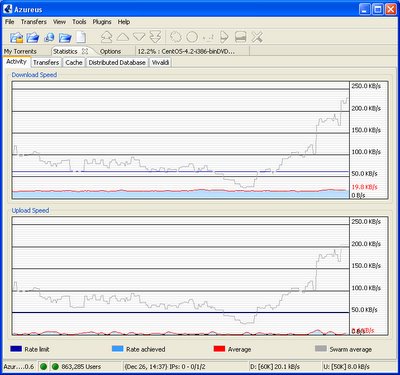
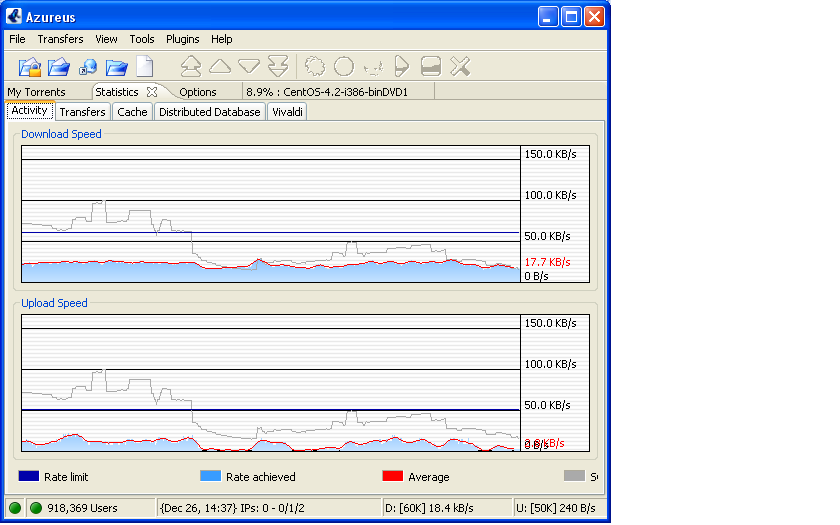
Azureus Bittorrent client is a pretty impressive example of a Java rich client based on SWT. It's responsive and rich graphically. Did they finally get the equivalent of Java2D in SWT? Azureus has lots of scrolling realtime graphs to diagnose why your 2GB download goes so slowly. .NET isn't your only choice for a rich client.
I should also mention Oxygen, an SWT desktop XML IDE also based on SWT. It's capable and snappy, and has a great XSLT debugger; but not as feature loaded as XML Spy.
I should also mention Oxygen, an SWT desktop XML IDE also based on SWT. It's capable and snappy, and has a great XSLT debugger; but not as feature loaded as XML Spy.
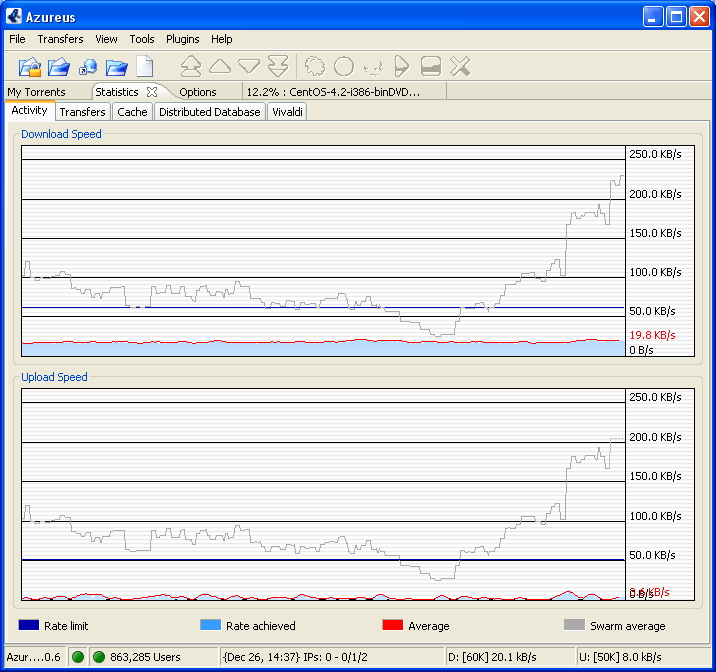
A nice scrolling real time graph from Azureus
Friday, December 23, 2005
Oldest Mozilla Bug (Not)
Every software organization has its oldest bug. The older the bugs are, the less likely you are to fix them. If I remember correctly, at my last company , after three years the oldest bug we never had fixed was number 11. Usually a bug becomes irrelevant after a number of years.
Three years ago today I reported a Mozilla CSS rendering bug. The details won't interest you, unless you're really into using CSS to replace tables. The workaround to the bug is: Use a table. Surely it's not the oldest bug in Mozilla, but it may be up there. And web developers are still actively encountering it.
Most interesting is the dynamic of getting a bug fixed in Mozilla. I reported the bug three years ago today, but it was a duplicate: A guy originally reported it on December 28, 2000. Today I thought it worthwhile to commemorate my third anniversary, and the approaching fifth anniversary, of Bug 63895:
I am celebrating today my third anniversary as a reporter of this bug. I reported it Dec 23, 2002 (http://bugzilla.mozilla.org/show_bug.cgi?id=186581 ) and was soon notified that it was a duplicate of this one.
In just a few days the bug will pass its fifth anniversary since originally reported by Stephen Clouse on Dec. 28, 2000, near the end of the last century.
I've subscribed to the "progress" of the bug over the years since then. Here are my picks for each year's highlights:
o 2001: A comment by Hixie (https://bugzilla.mozilla.org/show_bug.cgi?id=63895#c4 ). I didn't understand this one really ( I don't understand any of the technical comments really) but it seems really cool that Hixie has been on the case.
o 2002: Derek (https://bugzilla.mozilla.org/show_bug.cgi?id=63895#c16 ): "This seems like a pretty significant bug, considering that CSS2 positioning is supposed to end dependence on table-based layouts."
o 2003: Boris (https://bugzilla.mozilla.org/show_bug.cgi?id=63895#c25 ) complaining about "pushy bug reporters who demand things as their right without thinking about the fact that ..." yada yada.
o 2004: Joe (https://bugzilla.mozilla.org/show_bug.cgi?id=63895#c37) "Wow... 12-28-2000... Don't hold my breath eh?", followed by Martin's riposte (https://bugzilla.mozilla.org/show_bug.cgi?id=63895#c38) "Please keep those remarks to yourself, this doesn't help."
o 2005: ATom (https://bugzilla.mozilla.org/show_bug.cgi?id=63895#c43): "How are advantages of this behavior? According my opinion is it only disadvantage. How much authors use this behavior? How many pages can change of this behavior cause regression?"
I'm looking forward to lots more analysis and opinion on this bug in 2006!
Friday, November 25, 2005
Common sense
RESTful design is not an end in itself: If you find yourself adding complexity to honor the constraints of REST, consider the benefit of the complexity and only do it if the benefit is clear. Here's a case of a guy asking this perfectly ordinary question: How can I use POST to execute a query where the query string is too long to stuff into an URL? This question pops up once a year on the rest-discuss list.
Some responded with helpful suggestions to have the POST create a temporary resource, which when you GET it, returns the query results. Mark doesn't think this is restful. But I do, because the client and server understand that the semantics of whatever document told the client the URL to POST the query to, demand that the POSTed doc be a query document, and that the Location header in the response be the URI where the client can retrieve query results. It's all in the mime type of the document containing that link.
But that's neither here nor there. It's wrong to create this intermediate resource if you simply want to get the query results as if your URL were short enough to do a GET. It doesn't enhance interoperability, and it adds complexity to the server design, which now has to manage the lifecycle of these temporary resources. I'm not saying returning 303 is a bad thing; just that in the case where you really just want to emulate GET and workaround an artificial limitation, just POST the query and return the result in the entity body. This is perfectly RESTful, but that's beside the point: Keeping it simple is always a higher value than perfect RESTful design, as long as you don't degrade interoperability.
Subscribe to:
Posts (Atom)